
The Patch Window Is Closing: What We Took From Cisco Live 2026
Key Takeaways
Introduction
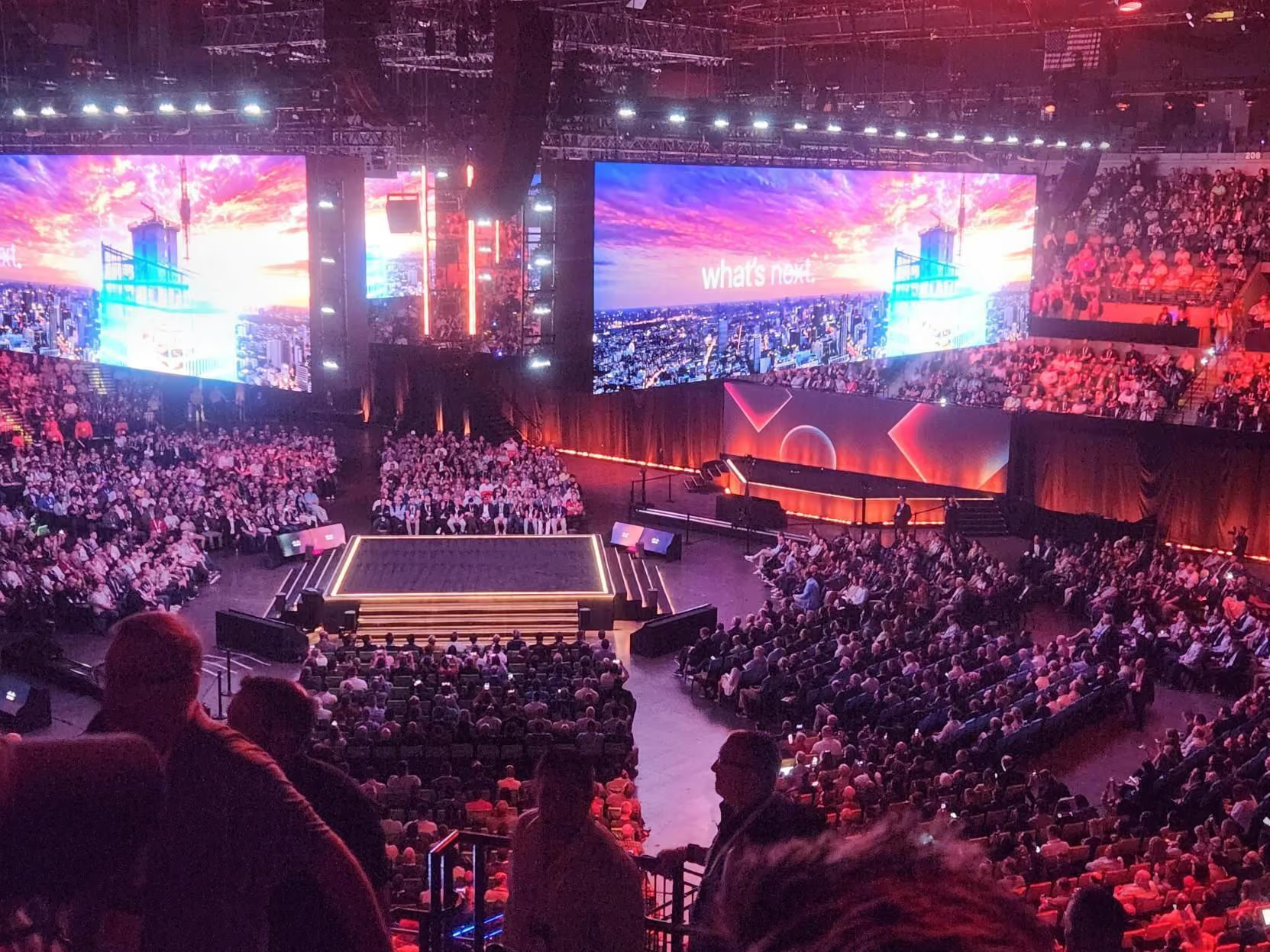
For years, handling a critical vulnerability followed a familiar rhythm. Test the patch, schedule a maintenance window, reboot, and accept some risk in the gap between. Cisco Live 2026 made the case that this rhythm is breaking. As AI speeds up how fast new vulnerabilities are found and weaponized, the time between disclosure and exploitation has compressed from weeks to days, and sometimes to hours. The week in Las Vegas was, at its core, about what you do when you can no longer afford to wait.
A quick word on perspective. Derive is an integrator, and Cisco is one of many partners whose roadmaps we track. We went to read the event for our clients, not to sell anyone a logo, so treat this as a field note rather than a pitch. We have also had a few weeks to sit with it and set it against the other major events of the season, so what follows is a reflection on what we saw with the backdrop of the entire industry, as opposed to an immediate reaction of what was directly in front of us.
Protection before the patch
The clearest answer to addressing this new compressed patching timeline was Live Protect, which Cisco describes as a kind of digital immune system. Rather than forcing an immediate upgrade, it deploys runtime controls that block exploitation of a known vulnerability while the device keeps running, holding the line until the permanent patch can be installed on your schedule. It can sit in monitor mode to watch, enforce mode to block, or be switched off when needed. The significance is not the features; it is the posture. For a hospital, a trading floor, or any environment that cannot reboot core infrastructure on demand, being able to protect first and patch later changes the math on risk. As of early July Live Protect is rolling out through an early-adopter program on specific platforms rather than broadly availability, so the honest framing is a capability to pressure-test, not yet a default you can assume everywhere.
The stack is consolidating, and that is a decision, not a default
The second throughline was consolidation. Firewall, SD-WAN, secure access, and endpoints are collapsing into fewer platforms. SD-WAN now runs on the secure firewall, and a single client agent is replacing the older patchwork of point tools, with the long-serving AnyConnect client reaching end of support in 2027. The upside is real: fewer consoles to watch, fewer seams between products, and fewer configuration and change errors that drive a large share of outages. But consolidating onto one vendor is a genuine tradeoff, not a free win. You gain simplicity and give up some of the flexibility and negotiating leverage that a best-of-breed mix provides. Which way a given client should lean depends on their risk profile, their team, and what they already run. That is a design decision, and it is precisely the kind of call we help clients make without a thumb on the scale for any one platform.
"Consolidation is the headline, but it is not automatically the answer. Fewer platforms can mean fewer seams to defend, or it can mean one bigger thing to lose. Which depends entirely on the design."
Yaroslav Samoylenko, Senior Sales Engineer.
Identity is where the fight actually is
If there was a center of gravity in the security track, it was identity. The message from the floor was consistent: zero trust is not a product you buy, it is continuous evaluation of trust, and identity sits at its core. The figures shared at the event put an identity component in roughly six out of ten breaches, with the common attacks having moved to MFA fatigue and session hijacking rather than brute force. The answer is adaptive, risk-based authentication that pulls identity signals together instead of judging each system on its own. For clients under compliance and cyber-insurance pressure, this is not abstract. It is increasingly what underwriters and auditors expect to see.
And underneath all of it, the question we keep hearing everywhere this year
Agentic AI is moving into real production, and the hard part is no longer the model. It is governance: giving each agent its own identity, keeping a registry of what is running, sandboxing what agents can touch, and auditing what they do. The discipline that came through most clearly was simple to say and hard to operationalize. The human stays in the loop and stays accountable for the output. We heard versions of that same message at more than one major event this season, which tells us it is an industry direction, not a single vendor's campaign.
Implementation considerations.
None of this is plug and play. A runtime shield still has to be switched on without disrupting production. A consolidated stack still has to be architected so it does not become a single point of failure. An identity-first model still has to fit the systems a client already depends on. The platforms keep getting more capable, which raises rather than lowers the stakes on how they are assembled.
Here is the uncomfortable part of a shrinking response window: the technology that closes it fastest is also the technology that punishes a sloppy build hardest. A runtime shield left in monitor mode protects nothing. A consolidated stack with one bad assumption becomes a single failure that takes everything with it. The speed only pays off if the assembly underneath it is sound, and that soundness is not something you buy out of the box. It is the reason clients in healthcare, financial services, and the public sector have leaned on us through years of these shifts, and it is why we sat through Cisco Live reading every announcement for how it survives contact with a real environment. If your window to respond is closing faster than your stack can keep up, that is the conversation to have. Let's have it.